What Does RUO Mean? Research Use Only Peptides Explained
Last updated: August 5, 2026
Research Use Only. This article is for informational purposes for qualified researchers. Compounds discussed are not drugs or supplements and are not for human or veterinary use.
What Does RUO Stand For?
RUO stands for Research Use Only. It is an intended-use designation applied to materials sold for laboratory research, and it appears on most research peptides. RUO describes what a product is intended for, not how pure it is. It is not a safety certification, not a quality grade, and not an approval for human use.
Last updated: August 5, 2026
| Category | Intended use | Manufacturing standard | Sterility and endotoxin testing | Typical documentation | Relative cost |
|---|---|---|---|---|---|
| Research Use Only (RUO) | Laboratory research use | No mandated production standard; quality systems vary by supplier | Optional. Endotoxin screening is common on better material; sterility testing usually is not performed | Batch certificate of analysis where the supplier publishes one | Lowest of the four |
| cGMP | Material destined for regulated manufacturing | Current Good Manufacturing Practice: validated processes, controlled environments, full batch records, periodic audits | Required and documented to defined specifications | Full batch record, validated method data, deviation and change control history | Substantially higher, commonly by an order of magnitude or more |
| Clinical grade | Material supplied for use in authorized human studies | Produced under cGMP with additional qualification for the specific study | Required, with defined release specifications | cGMP batch record plus study-specific qualification and release documentation | Highest of the four |
| In vitro diagnostic (IVD) | Testing human samples outside the body to produce a diagnostic result | Manufactured under a quality management system for diagnostic products | Defined by the product’s performance specification | Design history file, validated performance claims, labeled intended use | Varies widely by product and format |
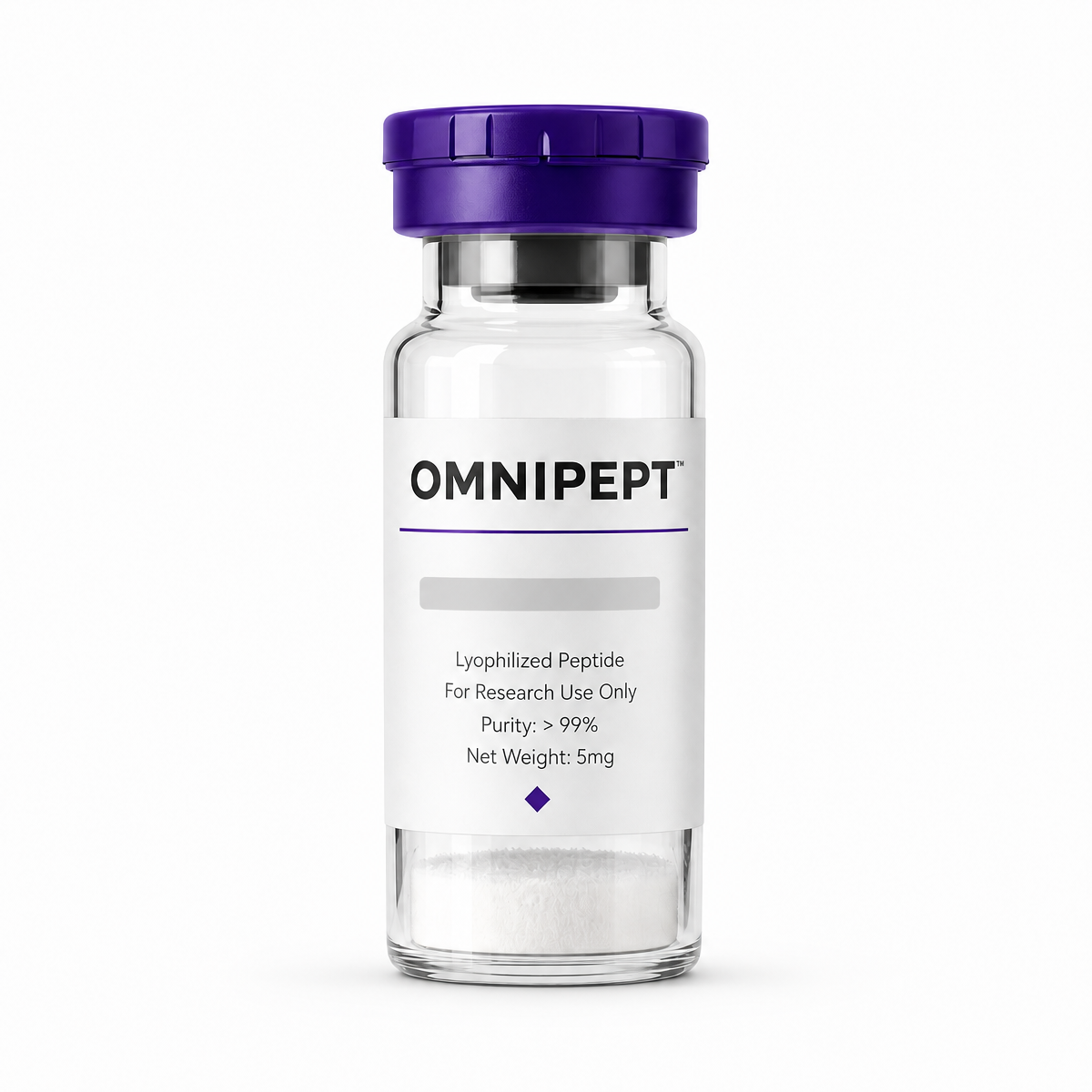
The wording that appears on an RUO label
The RUO designation is one of the most common phrases in the research peptide market in 2026, and one of the least explained. It appears on vial labels, product pages, and checkout disclaimers, usually with no definition attached. This guide covers what the phrase means, how it compares to the categories it gets confused with, and what documentation separates a well-characterized RUO peptide from a poorly characterized one.
RUO stands for Research Use Only. The three letters are shorthand for a statement about intended use: the material is offered for laboratory research and is not offered for diagnostic or human application.
Why research peptides carry the designation
The full statement on a research peptide label is usually some version of “For Research Use Only. Not for human use.” Some suppliers extend it to “For laboratory research use only. Not for human or veterinary use, and not for diagnostic or therapeutic purposes.”
By industry convention the wording does two things at once. It states the intended application, which is laboratory research, and it excludes the applications the material is not offered for: diagnostic, therapeutic, and human or animal administration. Both halves matter, because a label that says “research use” without excluding human use leaves the second question open.
What Are RUO Peptides?
Research peptides carry the RUO designation because they are synthesized and sold as laboratory reagents rather than as finished pharmaceutical products. The material is produced for in vitro work, meaning experiments performed outside a living organism.
The designation also defines the supplier relationship. A company selling RUO material is a chemical supplier providing reagents to researchers, not a pharmacy and not a manufacturer of finished products for administration. The label makes that boundary explicit at the point of sale.
What the RUO designation tells you
That relationship has a practical shape. A research peptide supplier synthesizes or sources peptides, has them tested, and ships them as documented laboratory reagents to qualified researchers and labs. It does not compound material for an individual, does not formulate finished products for administration, and does not provide guidance on use. What it delivers is a characterized reagent and the paperwork describing it, which is why documentation is the supplier’s real product and the subject of the rest of this guide.
RUO peptides are synthetic peptides sold as laboratory reagents under a Research Use Only designation. They are typically supplied as lyophilized peptides, meaning freeze-dried powder, in sealed vials with a stated nominal weight such as 10 mg.
What the RUO designation does not tell you
The designation tells you the intended application and the excluded applications, and that is the complete list:
Those four statements are the entire content of the label.
RUO vs GMP vs Clinical Grade vs IVD
The designation says nothing about purity, identity, sterility, endotoxin levels, or manufacturing controls. Two vials can carry an identical RUO label while differing substantially in every measurable property.
This is the most useful thing to understand about the phrase. It is a statement of intent, not a result. It is not issued by anyone, not earned through testing, and not verified by an outside party. A supplier applies it to describe what the material is for.
Research Use Only (RUO)
Which means the label cannot be used to compare suppliers. If two products both say “For Research Use Only,” that comparison has produced no information. What produces information is the laboratory documentation behind each lot.
RUO, cGMP, clinical grade, and IVD describe four different things: an intended use, a manufacturing standard, a supply designation for human studies, and a product category for diagnostics. They are frequently written as though they were four rungs on one quality ladder. They are not.
cGMP material
Sterility and endotoxin testing
No mandated production standard; quality systems vary by supplier
Clinical grade
Optional. Endotoxin screening is common on better material; sterility testing usually is not performed
Batch certificate of analysis where the supplier publishes one
In vitro diagnostic (IVD)
Material destined for regulated manufacturing
Current Good Manufacturing Practice: validated processes, controlled environments, full batch records, periodic audits
Why a peptide cannot be reclassified from RUO to GMP
Required and documented to defined specifications
Full batch record, validated method data, deviation and change control history
RUO vs IUO: Two Labels That Get Confused
Substantially higher, commonly by an order of magnitude or more
Material supplied for use in authorized human studies
What “Not for Human Use” Means on a Research Peptide
Produced under cGMP with additional qualification for the specific study
Required, with defined release specifications
What Separates a Well-Documented RUO Peptide
cGMP batch record plus study-specific qualification and release documentation
Testing human samples outside the body to produce a diagnostic result
Purity: what HPLC actually measures
Manufactured under a quality management system for diagnostic products
Defined by the product’s performance specification
Identity: what mass spectrometry confirms
Design history file, validated performance claims, labeled intended use
Varies widely by product and format
Net peptide content, and why a 10 mg vial is not 10 mg of peptide
RUO is an intended-use designation. It places material in laboratory research and excludes diagnostic and human application. Because it is not a production standard, no defined set of manufacturing controls applies, so the quality of RUO material depends entirely on the individual supplier’s own systems and testing ( Cell Culture Company ).
Current Good Manufacturing Practice, shortened to cGMP or GMP, is a manufacturing standard rather than a use category. It covers validated processes, controlled production environments, documented batch records, trained personnel, change control, and periodic auditing. The point is reproducibility: the same process, run again, produces the same material within defined limits.
What a certificate of analysis should contain
That system is expensive to build and maintain, which is why cGMP material costs considerably more than research-grade material of the same sequence, and why research organizations use RUO reagents where the application does not require a cGMP supply chain ( Thermo Fisher Scientific ).
Clinical grade is not a separate manufacturing standard. It describes cGMP material additionally qualified for use in an authorized human study, with study-specific release testing and documentation. The phrase describes a supply pathway, and it sits on top of cGMP production rather than beside it.
Batch-specific documentation vs. generic documentation
An in vitro diagnostic is a product used to test samples taken from the body, such as blood or tissue, to produce a diagnostic result. IVD is a product category defined by what the product claims to do, and those performance claims are validated during development.
The comparison that matters for peptide buyers is straightforward. RUO and IVD sit on the same axis, because both describe intended use, while cGMP sits on a different axis, because it describes how something is made. An RUO product is not a lower-grade IVD. It is a product that makes no diagnostic claim at all.
How to Evaluate an RUO Peptide Supplier
A peptide cannot be moved from RUO to cGMP by testing it more, because the category is defined by manufacturing history rather than by analytical results. Running additional assays on a finished lot produces more data about that lot. It does not retroactively create the validated processes, environmental controls, and contemporaneous batch records that define cGMP production ( Thermo Fisher Scientific ). Purity and category are independent facts, which is why a high purity figure on an RUO lot does not convert it into pharmaceutical material.
RUO means Research Use Only and IUO means Investigational Use Only. Both mark a product as not being offered for routine diagnostic use, but they mark different stages.
Questions worth asking before ordering
RUO material sits in the research phase. It is used to generate data, develop methods, and run laboratory experiments, and it carries no performance claim of any kind. IUO material sits one stage later, in the evaluation phase of a diagnostic product’s development, where performance is being formally assessed but the product is not yet offered for routine diagnostic use.
For research peptides, IUO almost never applies. It belongs to the diagnostic development pathway, and research peptides are laboratory reagents rather than diagnostic products under evaluation. IUO on a peptide listing is very likely a copy error rather than a meaningful distinction.
Signs that documentation is thin
“Not for human use” means the material is not offered, supplied, or intended for administration to people, in any form or amount. It is a statement about intended application, and it applies regardless of how pure the material tests.
The statement covers the material as sold. It is not conditional on purity, on the presence of a certificate of analysis, or on the buyer’s qualifications. A batch testing at 99.9% purity with confirmed identity and passing endotoxin results carries the same designation as any other RUO lot, because purity and intended use are separate questions. That is why the phrase pairs with “For Research Use Only” rather than standing alone: one half states what the material is for, the other what it is not for.
RUO and Related Terms: A Glossary
Because the RUO label carries no quality information, the meaningful difference between one RUO peptide and another is the laboratory documentation attached to the specific lot. Four measurements do most of the work: purity, identity, net peptide content, and contaminant screening.
High-performance liquid chromatography, or HPLC, separates a sample into its components and reports the target peptide as a percentage of everything the detector saw. That percentage is calculated from peak areas on a chromatogram, the trace the instrument produces, and it is usually written as area percent.
Common Misconceptions About RUO Peptides
For research-grade peptides, 98% or higher is the common benchmark, and well-characterized lots frequently report around 99%. Recent published OmniPept Global lots report average purities ranging from 99.09% to 99.96% across compounds.
The important limitation is what the number excludes. HPLC purity is a ratio of detected peaks, not a measure of the vial’s total mass, so water, counterions, and salts do not appear in it. A percentage published without a visible chromatogram is a claim rather than a result, which is the practical case for third-party purity testing by a laboratory with no stake in the sale.
“RUO grade” is not a purity tier
Mass spectrometry answers a different question: whether the molecule is the one on the label. The instrument ionizes the sample and measures the mass-to-charge ratio of the resulting ions, from which the molecular weight is calculated and compared against the theoretical weight of the labeled peptide.
This is necessary because purity and identity are independent. A sample can be 99% pure and still be the wrong compound, since a highly pure preparation of the wrong sequence is still highly pure. Purity alone cannot catch a mislabeled vial, and identity alone cannot catch a contaminated one ( Biosynth ).
Higher purity does not change the designation
In practice the two are run as a coupled method, LC-MS, where one separation feeds a UV detector for purity and a mass spectrometer for identity. On a certificate this appears as two results, commonly listed as “Purity (HPLC)” and “Identity (LC-MS).”
Net peptide content is the proportion of a vial’s powder mass that is actual peptide. The remainder is residual water and counterions such as acetate or trifluoroacetic acid left over from synthesis and purification.
Frequently Asked Questions
The figure on the label is a nominal fill weight, not a measured peptide mass. Across the industry, net peptide content commonly falls between roughly 60% and 90% of total weight depending on sequence, purification history, and lyophilization conditions, with residual water typically accounting for several percent by mass ( LifeTein ; AmbioPharm ). It is measured separately, usually by amino acid analysis, elemental analysis, or UV spectrophotometry, which is why it appears as its own line on a certificate rather than being derived from the purity figure.
This is the number most buyers never see, because most suppliers never report it. A certificate that lists net peptide content per vial describes what is physically in the container rather than what the label says, and reporting it per vial rather than as a single lot figure also shows how much containers vary.
What does RUO mean?
On one recently published OmniPept Global lot, BPC-157 10 mg lot PH-bc10-0509, the certificate records a net peptide average of 9.96 mg against the 10 mg nominal label, alongside 99.56% average purity. With the issuing laboratory, Independent third-party analytical laboratory, named on the report.
A certificate of analysis, or COA, is the laboratory report documenting a specific batch. A complete one carries:
What is an RUO peptide?
If any of the first four are missing, the document cannot be tied to the vial in front of you. For a field-by-field walkthrough with annotated examples, see what a certificate of analysis contains.
A batch-specific certificate reports one production run and can be matched to the lot number printed on the vial. A generic certificate is a single document reused across every batch of a product, often with the lot field blank or the date years out of step with current stock.
Is RUO good for peptides?
The distinction is not cosmetic. Independent testing is inherently batch-specific, because each production run is a separate event with its own result. A document that cannot be tied to a lot number defeats the purpose of having been tested at all.
Historical supplier pricing or fulfilment details from the source article were removed because they are not current OmniPept Global catalog data. Buyers should request a current quotation and destination-specific freight information.
What does RUO stand for?
Evaluating an RUO peptide supplier comes down to one question: can each specific claim be checked against a document. Because the RUO designation is self-applied, verification has to happen at the level of the individual lot.
For a wider view of how peptide suppliers compare on transparency and documentation practice.
Is “research use only” the same as “not for human use”?
None of these individually proves anything about the material. Collectively, they describe a supplier whose claims cannot be checked, which is the practical problem the RUO label leaves unresolved.
RUO (Research Use Only). An intended-use designation marking material as offered for laboratory research, not for diagnostic or human application.
What is the difference between RUO and IUO?
IUO (Investigational Use Only). A designation for a diagnostic product in its evaluation phase, where performance is being assessed but routine diagnostic use is not offered.
IVD (in vitro diagnostic). A product used to test samples taken from the body, such as blood or tissue, to produce a diagnostic result.
Is “RUO grade” a purity level?
GLP (Good Laboratory Practice). A quality system governing how non-clinical laboratory studies are planned, conducted, recorded, and reported, so results stay traceable.
GMP (Good Manufacturing Practice). A manufacturing standard covering validated processes, controlled environments, documented batch records, and auditing, aimed at consistent production.
What should a certificate of analysis for an RUO peptide include?
cGMP (current Good Manufacturing Practice). GMP as currently practiced, with “current” indicating that expectations track evolving methods rather than a fixed historical standard.
API (active pharmaceutical ingredient). The component of a finished drug product responsible for its intended activity, manufactured under pharmaceutical-grade controls.
Verify Before You Compare
COA (certificate of analysis). A laboratory report documenting test results for one specific batch, including identity, purity, and contaminant screening.
HPLC (high-performance liquid chromatography). A method that separates a sample under high pressure and reports the target compound as a percentage of everything detected.
Disclaimer
Mass spectrometry. A method that measures the mass-to-charge ratio of ionized molecules, confirming that a sample’s molecular weight matches the intended compound.
Chromatogram. The visual trace an HPLC instrument produces, where each detected component appears as a peak and peak area determines the purity percentage.
References
Lyophilized. Freeze-dried. Water is removed from frozen material under vacuum, leaving a dry powder more stable than the same peptide in solution.
Net peptide content. The proportion of a vial’s powder mass that is actual peptide, the remainder being residual water, counterions, and salts.
Similar Posts
Endotoxin. Bacterial cell wall components that can interfere with laboratory readouts, screened for using the Limulus Amebocyte Lysate assay.
Residual solvents. Traces of the organic solvents used during synthesis and purification that remain in the finished material and are measured against defined limits.
Where to Buy Klow Peptide Blend in 2026: 9 Research Suppliers Compared
6 Best Melanotan-2 (MT-2) Vendors: Where to Buy MT-2 Peptide in 2026
Top 10 Peptide Companies in the USA: Best Ranked Vendors (2026 Guide)
Where to Buy BPC-157 in 2026: 9 Research Peptide Suppliers Compared
Where to Buy CJC-1295/Ipamorelin in 2026: 10 Research Suppliers Compared
HPLC vs Mass Spectrometry: What Peptide Tests Prove
Leave a Reply Cancel reply
Verify before you buy
Every batch we release has a public certificate of analysis. Match your lot number to its report.